Hatt Clinic
February 10, 2025
October 26, 2017
Updated December 19th, 2025
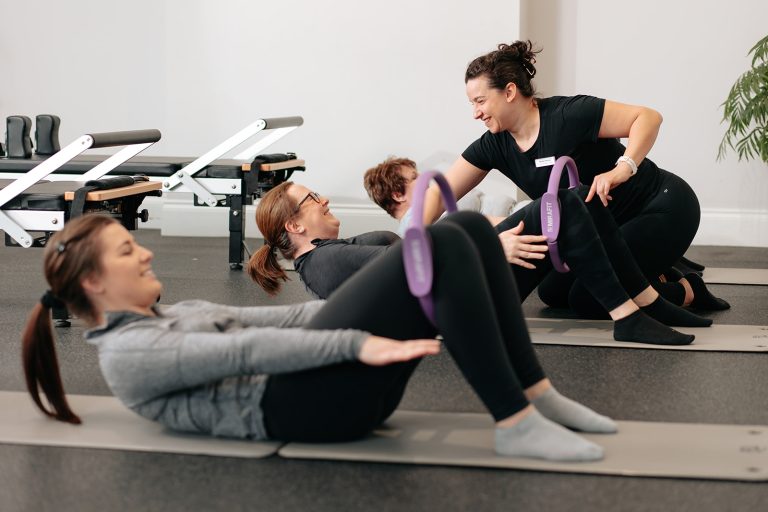
Pilates is a form of exercise. A Reformer is a piece of equipment that may be used in a Pilates session.
Most professional Pilates classes use a mix of different methods — and the Reformer might be one of those. Where that’s the case, we’d normally talk about the use of a Pilates Reformer or a Reformer in Pilates.
Pilates is designed to change and improve the way you move on a permanent basis.
Each session aims to re-balance your whole body by isolating and targeting typically weak muscle groups. When you learn to activate these muscles, you’ll start using them automatically in your everyday activities.
Whether you want to improve your sporting or athletic performance, or tend to your garden without back pain, Pilates can help.
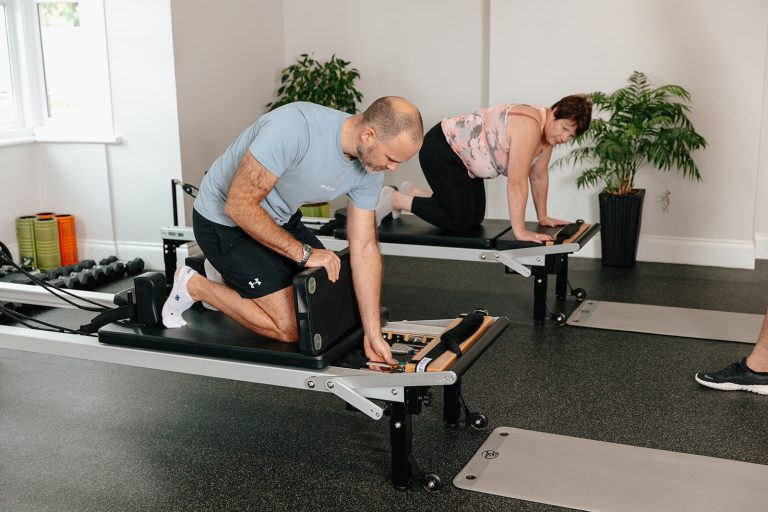
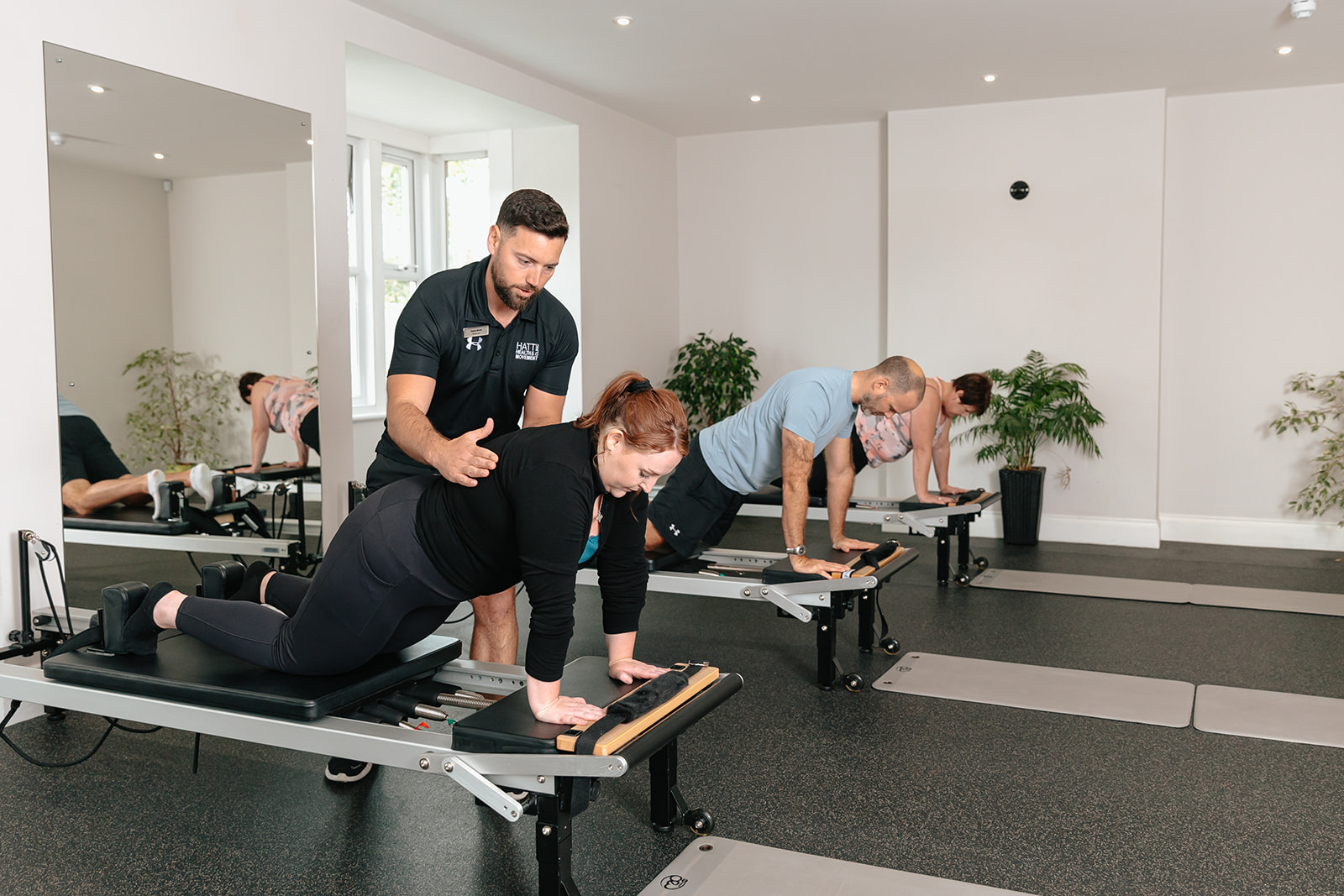
The Reformer is an original piece of equipment, designed by Joseph Pilates. It has a spring-loaded, sliding carriage that moves backwards and forwards on rails.
The Reformer is designed to support your movement while adding adjustable resistance that helps you build strength, control, and flexibility.
You lie, sit, kneel, or stand on the carriage and use straps and pulleys to move it using different parts of your body. By adjusting the level of resistance or assistance, each exercise can be tailored for the level of difficulty you need.
Watch the video below to learn more about how the reformer works.
Here are 12 benefits of using a Reformer in Pilates that will make a real difference to the way you feel and move.
Postural problems can affect a wide range of people. From schoolchildren carrying heavy backpacks to people with desk jobs, and older adults with sedentary lifestyles.
Pilates helps you improve your posture in two ways: by keeping your shoulders, spine and pelvis aligned while you’re moving. And by using the Reformer’s spring resistance to strengthen your postural muscles, helping you stand taller and straighter, and move more efficiently.
Strengthening and aligning your body reduces strain, so you’re less likely to develop aches and niggles.
In a study of sedentary office workers, Pilates on a Reformer was found to be a promising strategy for improving posture and psychosocial wellbeing.
The Reformer’s adjustable springs allow you to increase resistance as you get stronger. This helps you build strength in all your major muscle groups and your smaller muscles, which are often missed in other workouts.
If you enjoy lifting weights, using a Reformer in your Pilates sessions can help to improve your body’s mechanics, so you can lift more in the gym.
In a study of overweight and obese women, Pilates on a Reformer was shown to improve body composition, muscular strength, and muscular endurance in its participants.
Pilates can help improve your performance in sports and athletic activities.
Pilates on the Reformer helps you work on your core strength, balance and control to give you better coordination.
When you do sports and activities, you’ll be moving more powerfully and efficiently, with the capacity to generate more force or perform for longer with less fatigue.
In a study of amateur male soccer players, Pilates on a Reformer was found to improve physical and technical performance, with “significant enhancements in agility and explosive power”.
Pilates has been shown to reduce, and even eliminate, musculoskeletal pain.
Poor alignment, muscle imbalances and awkward movements are common causes of everyday aches and pains.
Using a Reformer in Pilates helps train your body to move efficiently and strengthens the muscles that support your joints. This helps to ease back aches, neck pain and other musculoskeletal issues.
In a study of women with chronic musculoskeletal pain, those who practised Pilates on a Reformer experienced a significant reduction in pain intensity. They also showed improved movement and better sleep patterns.
All of the exercises you’ll do in Pilates and on the Reformer will be targeting your core.
Your core includes the following deep core muscles:
These muscles keep your body stable as you control the movement of the Reformer carriage. Over time, they become stronger and more supportive, giving you better flexibility, balance and posture.
In a study of healthy adult women, the Reformer was found to have a bigger impact on core muscle activity, during basic core exercises, than a fixed platform.
Pilates works to improve your flexibility and control.
The exercises on a Reformer use gentle resistance and controlled stretching to increase your range of motion.
A study of sedentary women who practised Pilates on a Reformer found significant improvements in their flexibility after 8 weeks.
Pilates can give you a low-impact, full-body workout. There are hundreds of exercises you can do on the Reformer, which target muscles in every part of your body.
And because the Reformer uses resistance from the springs, it can help to strengthen, tone and condition your body without putting undue strain on your joints.
Pilates is the perfect low-impact exercise for recovering after an injury.
With its adjustable springs, the Reformer allows you to set the ideal resistance level. This means you can restore your strength, movement and balance gradually, at a pace that’s right for you.
By improving your strength, balance and flexibility, using a Reformer in Pilates will make you more resilient to future injuries, too.
Pilates can boost your physical and mental wellbeing.
When you practise Pilates on a Reformer, you focus on controlling your movements and breathing. This mindful approach is calming. It can reduce stress and improve your mood.
It can also help to manage physical pain and its associated symptoms.
In a study of women with chronic musculoskeletal pain, Pilates on a Reformer was shown to ease the symptoms of anxiety and depression.
The spring-loaded resistance of the Reformer in Pilates helps to build muscle strength, which improves the stability of your joints. This can reduce stiffness, allowing you to move more freely and smoothly.
After exercising regularly over time, many people notice improvements in their walking speed, general movement and range of motion.
Moving safely and freely are key to long-term relief from back pain. But they can be difficult to achieve.
When you have back pain, it feels like one wrong move could cause a painful spasm. This can make you move awkwardly, which often makes things worse.
Pilates works to strengthen the core and back muscles that support your spine. The Reformer can guide you into safer ways to move, which helps reduce the fear of moving freely.
In a study of women with lower back pain, exercising on the Reformer was shown to deliver effective results. By strengthening the muscles supporting spinal stability, the exercises reduce stress on the intervertebral discs. This helps to improves spinal alignment and reduce pain.
As you move the Reformer carriage back and forth, your body is constantly adjusting to stay balanced. This trains your stabilising muscles to address any imbalance and improve your coordination.
Over time, this will make you more stable when standing and walking, improving your confidence and reducing your risk of falls.
In a study of older adults, those who practised Pilates on a Reformer showed a reduced risk of falls and significant improvements in static and dynamic balance.
Now you’ve seen the benefits of the Reformer in Pilates, would like to try it for yourself?
We offer Pilates classes at all three of our clinics, in Devizes, Frome and Marlborough. Sessions include time on the Pilates Reformer.
Classes are led by our experienced clinical team and are suitable for people of all ages and abilities.
We keep our class sizes small, with a maximum of five people, which means you’ll always get the personal attention and guidance you need.
Classes are available 50 weeks of the year, with a break over Christmas. And a flexible booking option offers the freedom to move between classes and work around busy schedules.
To get started, book an initial Pilates session online. This is an introductory 1:1 appointment that will lead you into the group classes.
Alternatively, you can email us at: enquiries@hattclinic.co.uk
Or call your nearest clinic:
Devizes: 01380 730473
Frome: 01672 516580
Marlborough: 01373 452604
Hatt Clinic
February 10, 2025
Hatt Clinic
April 06, 2017
Hatt Clinic
October 31, 2017