
Hatt Clinic
November 21, 2024
November 02, 2017
Updated December 29th, 2025
A verruca, also known as a plantar wart, is a wart on the foot. Verrucas are caused by the human papillomavirus (HPV) and most commonly appear on the soles of the feet or toes.
The warts are contagious and are typically spread through contact with contaminated surfaces. It’s common to get them from communal areas, like public showers and swimming pools, where people are walking around with bare feet.
At first, a verruca will present as a small white/pink bump on the foot.
A verruca can develop as a single wart or as multiple, tightly packed individual warts. They can range in size from a millimetre to over a centimetre.
If the verruca forms on a weight-bearing surface, like the heel, it can grow deep into the skin. Over time, the skin around the outer edge of the verruca will thicken and a black dot will appear in the centre. Harder skin may form over the top, which will make it more painful to walk on.
On a non-weight-bearing surface, like the side of a toe, the verruca will protrude outwards, but is less likely to be painful.
If you’re unsure if you have a verruca, a podiatrist or foot health practitioner will be able to diagnose it for you.
Verrucae are harmless, but can be contagious.
They can spread to other areas of your feet — and to other people — either through direct contact or contact with contaminated surfaces.
They can also be painful if they’re on a weight-bearing part of the foot.
This is why many people prefer to get them treated rather than leave them to clear up on their own.
Many people buy over-the-counter treatments from their pharmacist. These usually come in the form of preparations you apply to the verruca or medicated plasters.
But they’re not suitable for everyone and they don’t always work.
Most over-the-counter verruca treatments are acid-based and work by breaking down and destroying the verruca. They need to be applied directly to the affected area so they don’t irritate the surrounding skin. But this can be a challenge if you have to apply the treatment yourself and the verruca is hard to reach.
Over-the-counter treatments aren’t as strong as a professional podiatric product that a podiatrist would use. Most products need daily application over several weeks or months. If you can’t commit to this routine, you may find the treatment isn’t as effective. And if your verruca is buried deep under the skin, they may not penetrate far enough to treat it.
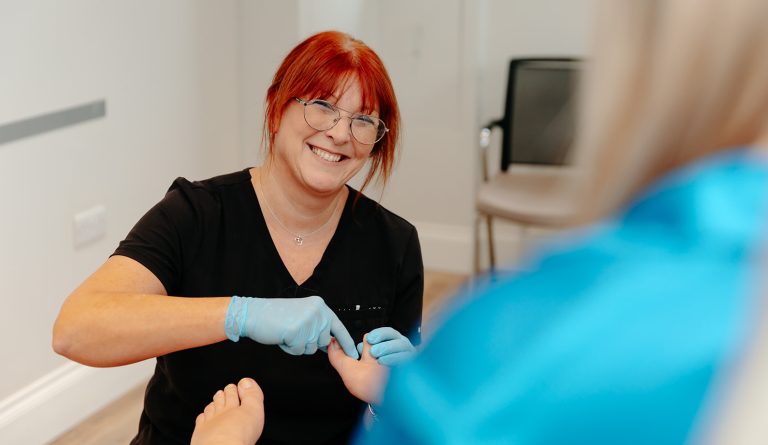
Hatt Clinic’s expert podiatrists and foot health practitioners recommend the Swift verruca treatment, which we offer in our podiatry clinics.
Swift is a professional treatment that can only be provided by an experienced podiatrist or foot health practitioner.
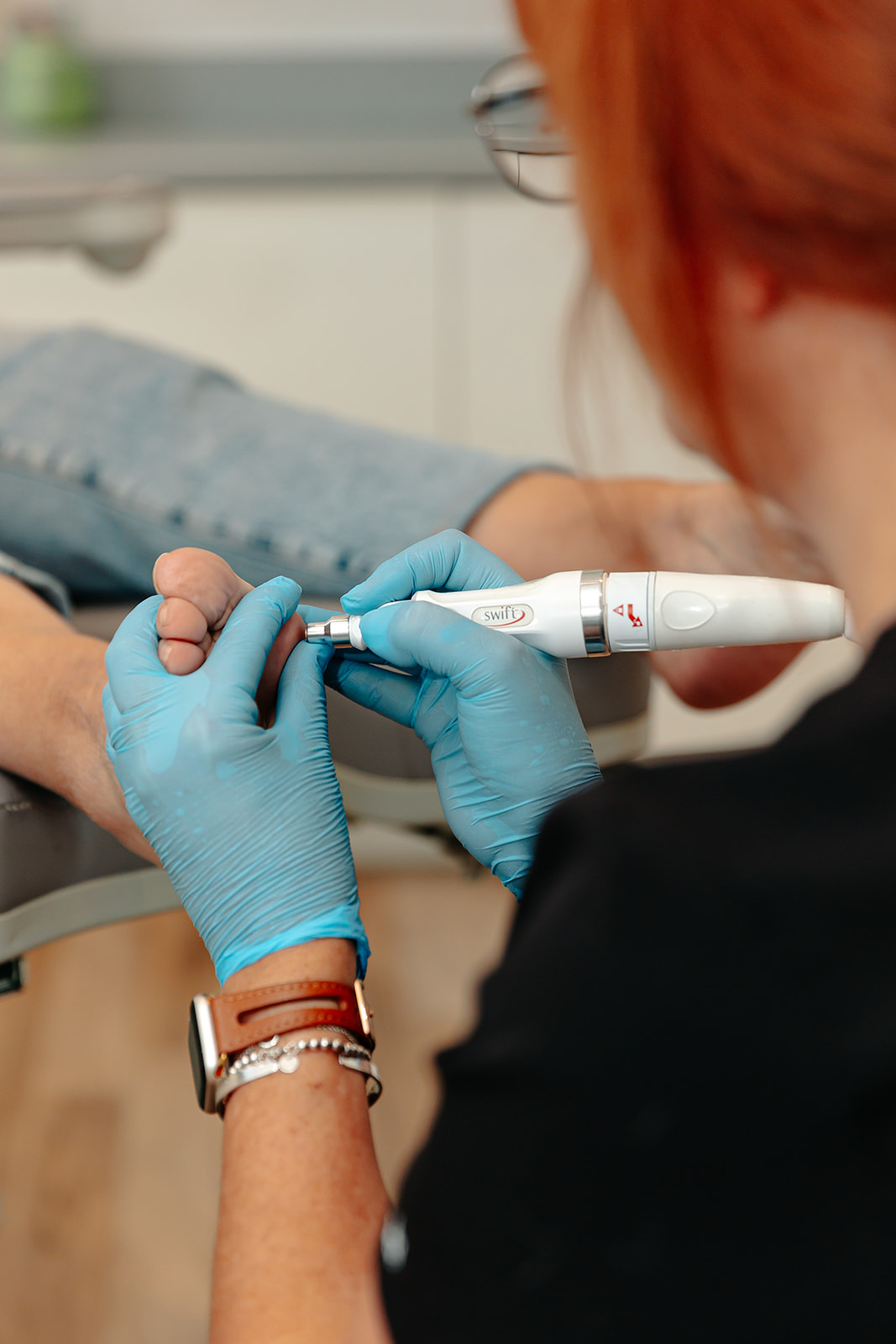
It’s a non-invasive treatment, which uses microwave technology to treat the verruca.
Your foot care specialist will use a probe to apply targeted microwave energy directly into the verruca. This helps to destroy the infected cells and triggers your body’s own immune system to fight the underlying virus. Alongside the treatment, we provide Zinc supplements to support your own immune response.
Our podiatrists and foot health practitioners recommend Swift verruca treatment for the following reasons:
Swift is a non-invasive treatment, which takes seconds to deliver and causes minimal discomfort during and after application.
The treatment doesn’t damage your skin, so you won’t need any post-treatment dressings or aftercare. And, in most cases, you can go straight back to your normal activities.
The success rate with this treatment is approximately 84%, which is exceptional for a non-invasive therapy.
For children under 16, the verruca typically disappears within four weeks of the first Swift session.
If the verruca persists, further sessions can be arranged as needed.
For adults and over-16s, our Swift treatment package includes up to four sessions of treatment.
The sessions are spaced four weeks apart, which allows time for your body’s immune response to take effect between each treatment.
The package includes a follow-up review, eight weeks after the final treatment, then a further follow-up eight weeks after that.
If you still have questions about Swift verruca treatment, you should find the answers below.
No, there are some exceptions. Your foot care specialist will assess your verruca and your suitability for Swift verruca treatment during your initial appointment.
If you’re not a suitable candidate for Swift, they should be able to suggest an alternative.
Unlike acid-based treatments and freezing, Swift triggers your body’s immune system to recognise and fight the underlying virus. This is a more effective way of treating the verruca and preventing it from coming back.
Yes, if needed we can treat multiple verrucae and on both feet.
Yes, many patients want to try Swift because other remedies haven’t worked for them.
However, we can’t use Swift if your feet are still recovering from those treatments. Your foot care specialist will need to check your feet to ensure they have fully recovered before offering Swift.
No, but you might experience mild discomfort for a few seconds while the probe is applied.
Patients describe it as a sudden burst of heat, or the feeling of standing on something sharp. This sensation will subside as soon as the probe is removed.
After the probe application on the second treatment, the dead skin cells are gently removed by your foot care specialist.
This will depend on how deep your verruca is buried. Your podiatrist will determine how deep the treatment needs to go to give you the best chance of destroying all the affected tissue.
Because Swift triggers an immune response, there’s less chance of the verruca reappearing compared with other treatments. However, there’s no guarantee of permanent immunity with any treatment.
Swift is ideal if you’re looking for an effective and non-invasive verruca treatment.
Hatt Clinic offers Swift verruca treatment at our podiatry clinics In Devizes and Frome.
To book an appointment online, visit our online booking page and select initial chiropody/podiatry from the menu.
Alternatively, you can email us at: enquiries@hattclinic.co.uk
Or call the clinic:
Devizes: 01380 730473
Frome: 01672 516580
Hatt Clinic
November 21, 2024
Hatt Clinic
February 03, 2026
Hatt Clinic
April 07, 2017